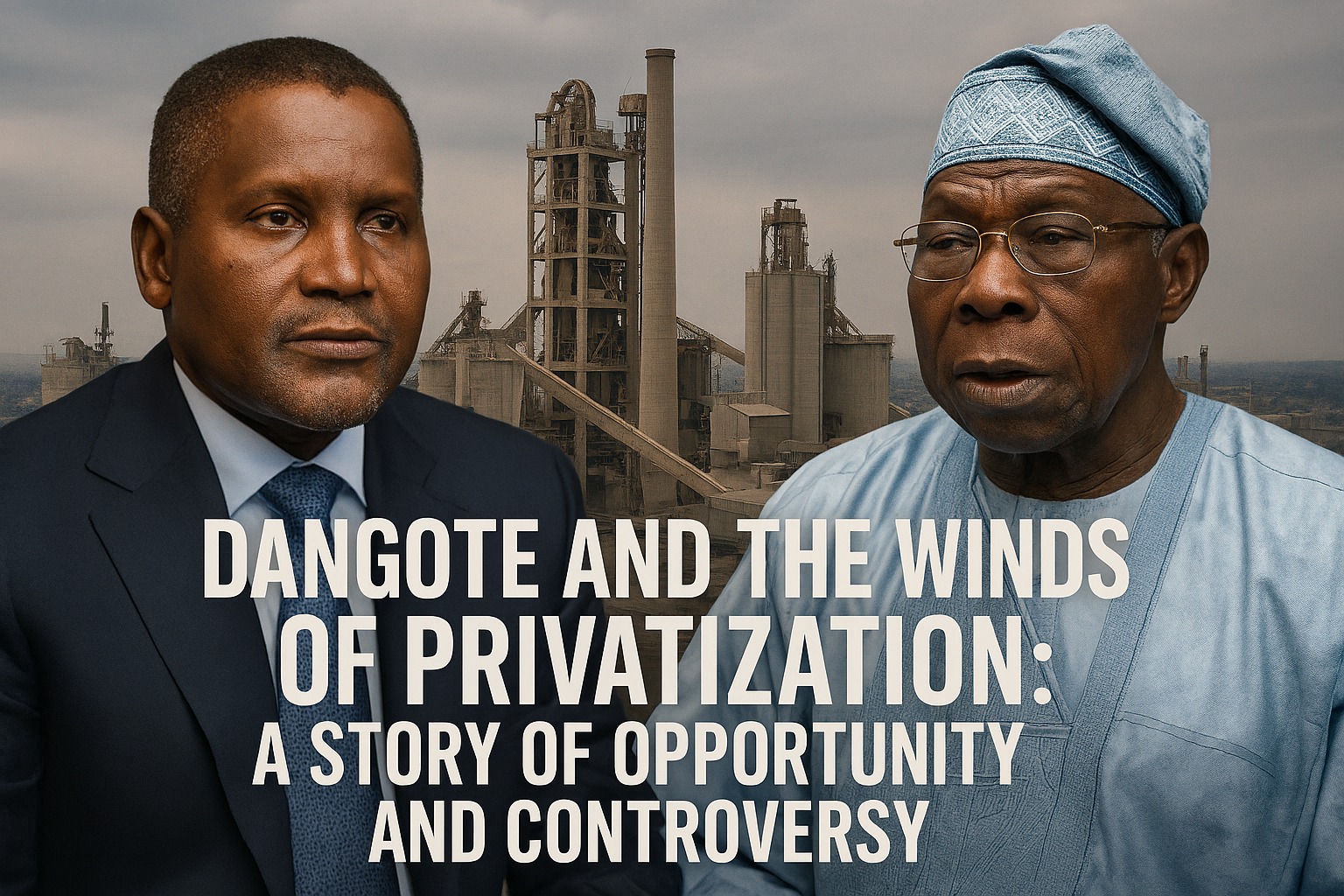
Dangote and the Winds of Privatization: A Story of Opportunity and Controversy
On May 29, 1999, history was made in Nigeria. The retired military general, Olusegun Obasanjo, was sworn in as the nation’s second executive president, marking the dawn of a new civilian era after years of military rule. For many Nigerians, it was a moment of hope—a chance to rebuild a country long weighed down by corruption, inefficiency, and government waste. For one man in particular, Aliko Dangote, it was also a turning point that would reshape his destiny.
Dangote was no stranger to the corridors of power. As one of the wealthy Nigerians who had contributed heavily to Obasanjo’s political campaign under the banner of the People’s Democratic Party (PDP), he understood the likely economic direction of the new administration. Obasanjo had built a reputation as a disciplined soldier, and now, as president, he wasted no time in declaring war on government inefficiency.
The Era of Privatization
Obasanjo’s philosophy was simple: government-owned corporations had become “drain pipes” on the economy. Decades of mismanagement had turned once-promising enterprises into liabilities, consuming billions of taxpayer naira without delivering meaningful services. From railways to electricity, postal services to housing, successive administrations had poured an estimated ₦80 billion (about $6 billion) into subsidized public services between 1960 and 1999. Yet the results were dismal.
Determined to change course, Obasanjo launched an aggressive privatization policy. The newly established Bureau of Public Enterprises (BPE) was tasked with overseeing the sale of non-performing corporations. The idea was bold: resuscitate those that could be revived with competent management, and sell off those beyond repair.
This was the moment Dangote had been waiting for.
Dangote’s Strategic Moves
Through open bidding, Dangote put his legendary negotiation skills to work. From textiles to agro-allied industries, from sugar to cement, the Dangote Group systematically acquired struggling businesses and breathed new life into them. Factories that had once been silent began to hum again, jobs were created, and production surged.
Yet, as Dangote’s empire expanded, so did the whispers. Was his meteoric rise purely the result of business acumen, or did his closeness to Obasanjo tilt the scales in his favor? After all, it was not the first time their paths had crossed. Back in 1977, when Obasanjo was Nigeria’s military head of state, Dangote had secured his first major break as a cement importer. Now, in 1999, with Obasanjo back as an elected president, Dangote was once again positioned to benefit—this time on a much larger scale.
The Controversies
The privatization program remains one of the most debated chapters in Nigeria’s economic history. Critics questioned whether the sales were clean and transparent. Were officials of the BPE compromised? Did Dangote receive preferential treatment as one of Obasanjo’s chief supporters?These questions continue to echo in Nigeria’s public discourse. For some, Dangote’s story is one of vision and boldness—an entrepreneur who seized opportunities and transformed industries. For others, it is a tale of privilege and political connections, where access to power opened doors that might have remained closed to others.
Closing Reflection
The story of Dangote and Obasanjo is not just about privatization or wealth. It is about the complex interplay between politics and business in Nigeria’s journey toward modernization. It raises uncomfortable but necessary questions: Can true industrial growth emerge without political influence? And when opportunity meets power, does it always leave room for fairness?
What is undeniable is that Dangote’s rise during the Obasanjo years reshaped Nigeria’s economic landscape. Factories revived, industries expanded, and a new era of private-sector dominance began. Whether viewed as coincidence or calculated advantage, the alignment of Obasanjo’s policies and Dangote’s ambitions created a legacy that still defines Nigeria’s economy today.
In the end, Dangote’s story reminds us that history is rarely straightforward. It is woven from ambition, opportunity, controversy, and vision. And sometimes, the very questions that remain unanswered are what make the story worth telling.