Bank of Uganda – The Genesis
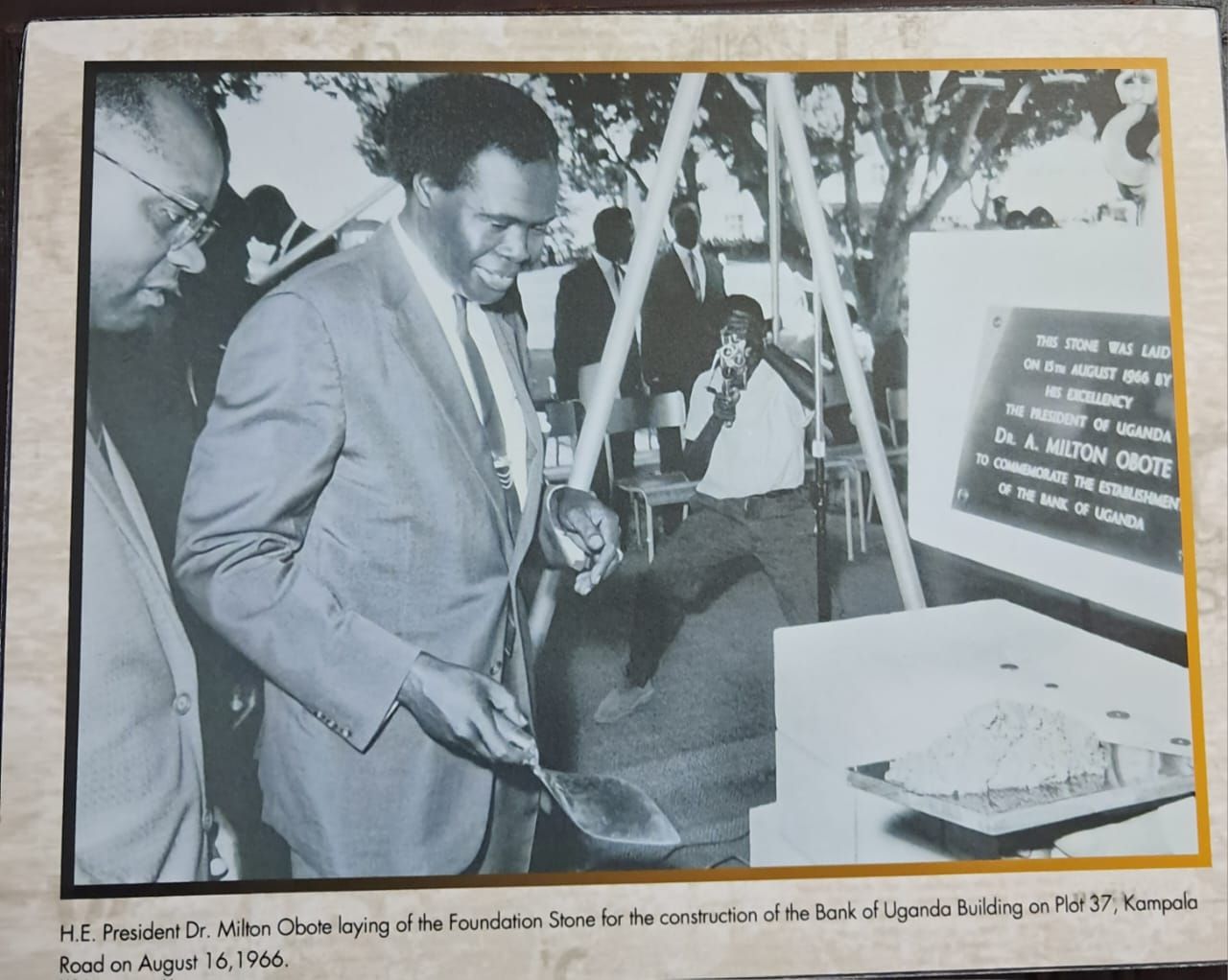
On 15 August 1966, a warm and dry day, the Bank of Uganda—the country’s long-awaited central bank—officially opened its doors and issued Uganda’s national currency, initially in the form of banknotes. By all accounts, it was an auspicious occasion. The event also marked the laying of the foundation stone for the Bank’s headquarters at Plot 37/43 Kampala Road, a building that would later become one of Uganda’s most enduring financial landmarks.
While Kenya chose to appoint an expatriate central banker to lead its newly established central bank, the Central Bank of Kenya, Uganda and Tanzania made a deliberate decision from the outset to entrust the leadership of their central banks to indigenous Africans.
In May 1965, Uganda’s Minister of Finance, Mr. Kalule Setala, visited London. During his visit to the Bank of England, he discussed Uganda’s preparations for establishing its own central bank. Accompanied by Uganda’s High Commissioner to the United Kingdom, Mr. Timothy Bazarabusa, and Mr. A.G.P.M. Sentongo, Permanent Secretary of Finance and Secretary to the Treasury, Mr. Kalule met the Governor of the Bank of England, the Earl of Cromer, at the Bank’s headquarters on Threadneedle Street in London.
Having outlined the circumstances that had led to the decision to dissolve the East African common currency system administered by the East African Currency Board and establish independent central banks with separate national currencies, Mr. Kalule requested the Bank of England’s assistance in staffing Uganda’s new institution. Specifically, he sought the services of three experts: a senior executive initially described as a General Manager, an accountant, and an exchange control specialist, whose expertise was considered particularly urgent.
Following the announcement of the creation of the Bank of Uganda in the Finance Minister’s budget speech on 10 June 1965, efforts to recruit expatriate experts from the Bank of England accelerated. It had already been agreed that the Governor would be a Ugandan national and that the second most senior position would be filled by an expatriate expert from the Bank of England. The remaining issue concerned the appropriate designation for this position.
During discussions with Bank of England officials, Mr. Kalule referred to the position as that of General Manager. However, officials at the Bank of England considered it unusual to assign such a title to an officer who would effectively serve as second-in-command to the Governor. In their view, the more appropriate designation was Deputy Governor, with any additional expatriate experts serving under that office.
The Bank of England believed that, given the crucial role its expert would play in advising on legislation and helping establish the Bank of Uganda, he should rank directly below the Governor. They further argued that inserting another official between the Governor and the Bank of England representative could undermine the effectiveness of the arrangement. As a matter of principle, the Bank of England considered a three-year assignment appropriate for the senior officer.
The recruitment process was overseen by John De Loynes, the Bank of England’s representative and technical adviser seconded to the East African Currency Board in Nairobi. It was through De Loynes that the Ministry of Finance in Entebbe conducted much of its correspondence during these critical negotiations.
Accordingly, on 8 July 1965, Mr. A.G.P.M. Sentongo wrote to De Loynes to clarify the status of the proposed General Manager. In his letter, Sentongo confirmed that the Minister of Finance had no objection to redesignating the position as Deputy Governor and agreed that the Bank of England nominee would serve as the second-ranking official in the institution.
At the time, the Bank of England remained one of the world’s most influential central banking institutions. Uganda’s request for urgent assistance in exchange control administration was repeatedly emphasized. Nevertheless, it was not until mid-August 1965, after several unsuccessful attempts, that the Bank of England was finally able to propose a suitable candidate for the position of Deputy Governor.