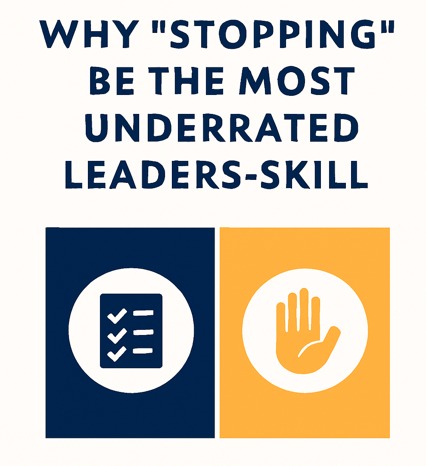
Knowing when to stop
Peter Drucker is quoted to have made a statement that stood out as the wisest:
“We spend a lot of time teaching leaders what to do. We don’t spend enough time teaching leaders what to stop. Half the leaders I have met don’t need to learn what to do. They need to learn what to stop.”
How true. Think about your own organization. When was the last retreat or training session titled “Stupid Things Our Top People Do That We Need to Stop Doing Now”? When was the last time your CEO gave a motivational talk focused not on his strengths, but on his negative traits and his efforts to stop destructive behaviour? Can you even imagine it? Probably not.
There are reasons for this. Organizations thrive on momentum and positivity. Everything is framed as doing something:
• We will start paying attention to our customers (instead of stopping talking about ourselves).
• We must begin to listen more attentively (instead of stopping the habit of fiddling with our phones while others speak).
Recognition systems reinforce this bias. We get credit for doing something good. We rarely get credit for ceasing to do something bad. Yet they are two sides of the same coin.
Consider sales. A colleague lands a huge order and returns to the office triumphant, retelling the story for months. But what if, during that sales call, they realized the deal would actually cost the company money? What if they stopped negotiating and walked away? That decision might save the company more than the big sale ever earned. Yet no one celebrates the bad deal avoided.
History offers bigger lessons. Gerald Levin, the much‑admired chairman of Time Warner in the 1990s, was hailed as a visionary for cable TV and HBO. But in 2000, he merged Time Warner with AOL in what was then the largest corporate merger in U.S. history. The result? Disaster. The stock lost 80% of its value, employees lost retirement savings, and Levin lost his job, his wealth, and his reputation.
Now imagine if Levin had stopped. If he had applied the brakes and walked away from the deal, we might never have known. There would be no press conference announcing “We are not merging.” It would simply be a bad decision avoided. And yet, that single act of stopping could have preserved his legacy.
That’s the paradox: stopping rarely gets attention, but it can be as crucial as anything we do. Outside the workplace, we congratulate ourselves for stopping bad habits all the time like quitting smoking, cutting toxic relationships, avoiding reckless choices. Inside organizations, however, we glorify action and overlook restraint.
The lesson is clear: leadership isn’t only about what we start. It’s also about what we stop.
Digested read from What Got You Here Won’t Get You There by Marshall Goldsmith.